japanese
Toward a New Coastal Spatial Model for Living with Water along Osaka Bay
- Can flood protection and waterfront engagement coexist in the era of climate change?
As sea levels rise and flood risks intensify, coastal cities around the world are being forced to rethink how they live with water. Most adaptation strategies prioritize protection — raising barriers, reinforcing infrastructures, and separating urban life from the waterfront.
But what if this separation itself is part of the problem?
In many Japanese coastal cities, massive levees and seawalls stand between the city and the sea. While these structures protect urban areas from flooding, they also disconnect everyday life from water — physically, visually, and psychologically. As a result, the relationship between people and coastal environments may be gradually fading from daily awareness.
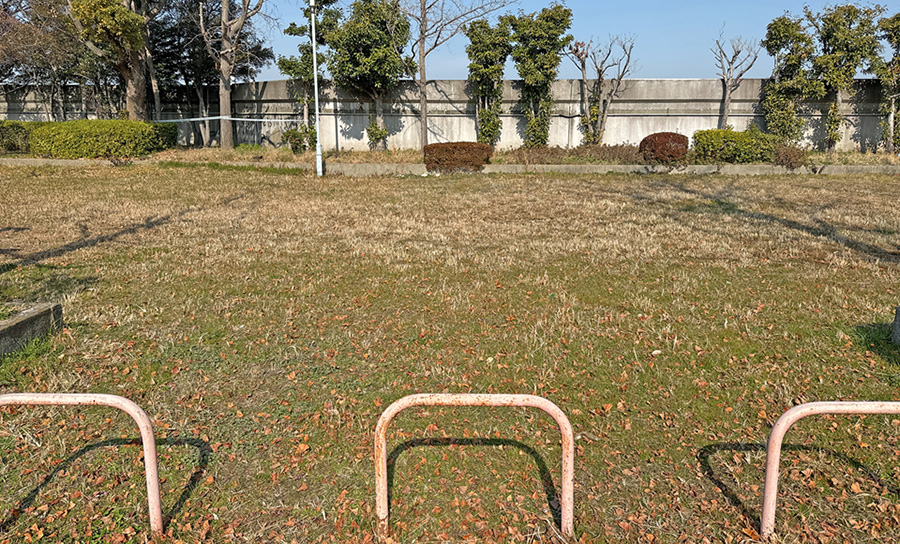
A waterfront park — yet the water remains invisible behind the levee.
This research asks a simple but fundamental question:
Can flood resilience and waterfront engagement be reconnected — not only through spatial redesign, but through changing people’s awareness of water?
To explore this question, we investigate five waterfront wards of Osaka City facing Osaka Bay (Nishiyodogawa, Konohana, Minato, Taisho, and Suminoe). The study integrates analyses of coastal cross-sectional forms, everyday waterfront activities, global climate adaptation strategies, spatial possibilities along the coast, and the evolving relationship between spatial form and human awareness.
Rather than proposing a purely physical redesign, this project develops an awareness-based coastal model — one that explores how coastal space, human behavior, and collective perception can be reconnected in the climate-change era.
This project reframes coastal adaptation as a question of awareness, not only infrastructure.
Coastal Cross-sectional Forms:
Focusing on five wards of Osaka City facing Osaka Bay (Nishiyodogawa, Konohana, Minato, Taisho, and Suminoe), we examined the cross-sectional relationships among the seaward side (sea and river mouths), levees, and inland urban areas (streets and blocks).The current conditions were analyzed from the perspective of accessibility to water.
research paper summary
Activities along the Coast:
An analysis of 1,100 social media posts associated with waterfront place names in the five Osaka Bay wards (Nishiyodogawa, Konohana, Minato, Taisho, and Suminoe) identified 57 distinct types of activities.These activities include exercise, strolling, observation, various leisure activities, and non-leisure uses.
research paper summary
Sea-Level Rise Adaptation Strategies in Cities Worldwide:
A review of resilience strategy documents from 48 coastal cities affiliated with the Resilient Cities Network revealed three primary approaches for maintaining connections with the sea:
1.Enhancing accessibility to the coastline so that people can directly experience their connection to the sea;
2.Increasing the value of coastal areas to strengthen the relationship between the city and the sea;
3.Preserving the relationship between land and sea from the perspective of coastal ecosystem conservation.
In addition, these strategies often emphasize the importance of the process of developing innovative and experimental adaptation measures.
research paper summary
Spatial Possibilities along the Coast:
In collaboration with students, we explored possibilities for coastal reorganization and developed preliminary proposals in Nishiyodogawa Ward (2023) and Minato Ward (2024).These proposals have been published on this website.
Preliminary Proposals in Nishiyodogawa Ward Nishiyodo Waterfront Project
Preliminary Proposals in Minato Ward Minato Waterfront Project
Reconsidering Form and Awareness:
The preliminary coastal reorganization proposals developed with students were exhibited at workshops and community events in the respective districts, where we exchanged ideas with local residents.
May 2024, Nishiyodogawa Ward Office: Exhibition at the Nishiyodo Disaster Prevention Café
March 2025, KLASI COLLEGE: Presentation at the Minato Ward Placemaking Workshop
Is the Current Form of the Coastline Adequate?
(Ongoing)
Reference
Resilient Cities Network
Resilient Boston Harbor
Rachel Dovey, Resilient by Design and Before Disaster, Landscape Architecture Magazine, January 19 2018
Hosei University Center for Regional Research, 2019, Report on Local Climate Change Adaptation in Japan: Toward Mainstreaming, 57-62
This research is supported by JSPS Grant-in-Aid for Scientific Research JP21K05656.